Food, Glorious Food

January 31, 2014

CHW LogoChildren’s Hospital of Wisconsin has a vision that the children of Wisconsin will be the healthiest in the nation.  By some measures we do pretty well, though we continue to struggle with a higher level of disparities than other states.  For example, according to the National Initiative for Children’s Healthcare Quality (NICHQ), Wisconsin has a lower rate of obesity/overweight among children (31%) than the national average; our ranking is 12th best, and has improved since 2003.  However, when we look at the disparity in obesity, we fare poorly: 17 of 22 when measured by race, and 32 of 35 when based on income.

But let’s step back a second.  Is it really OK to have almost one-third of our 10-17 olds overweight?  Consider this: Oxfam reports the US ranks 121 out of 125 nations in its rate of diabetes and obesity.  I’m not sure it’s enough to aim to be the best in the nation.  That would still leave our kids in sad shape from a global perspective.  Indeed, despite high ratings for food quantity, quality, and affordability, the US is ranked only 21st in the overall index, due to abysmal statistics on health impact of the food we (over)eat.

And let’s be clear – this is not solely, or even largely, an issue of poor choices or lack of willpower.  It’s primarily a societal issue.  First, while on a global scale obesity is largely associated with affluence, within the developed countries there is an inverse relationship between income and obesity.  Much has been written about “food deserts” in inner cities – neighborhoods without access to healthy food options.  But even when there is such access (and Milwaukee actually does not have food deserts as defined by the USDA), healthy foods may be out of reach.  A study from University of Washington showed that the most energy-dense foods, high in saturated fats and low in other nutrients (think potato chips, Oreos, and Hot Pockets) are 10 times less expensive than the least energy-dense (salad, fresh fruit) on a per-calorie basis ($18.16/1,000 kcal as compared to only $1.76/1,000 kcal).  Worse, the most nutritious foods rose in price by almost 20% over a 2-year period, while the least nutritious actually got even cheaper.  No wonder people with limited income or food stamps pick “junk food” – it may be the only way to afford enough calories to feed the family.

In part, this reflects basic economics – junk food is simply cheaper to produce than the healthy stuff.  But it’s made worse by national farming policy (as enshrined in the latest farm bill), which continues to subsidize industrial producers of products destined to be converted to, in Michael Pollan’s memorable phrase, “edible foodlike substances.”

What can we do?  We already have made important steps, like providing healthier food choices for patients, families, and staff.  Here are some additional suggestions:

  • Let’s increase awareness of nutrition as an issue we ask about at patient encounters throughout the system.  We can be intentional asking patients and families about food insecurity, or concerns about their child’s weight.  And it needs to start early; this week’s New England Journal of Medicine has a study demonstrating that childhood obesity is largely present by age 5.
  • We can leverage our considerable organizational expertise in feeding and nutrition by creating a pediatric nutritional program of excellence, which can be a resource for providers, patients, and families.  Then we need to steer them toward educational resources to counter the massive advertising by the “edible foodlike substance” industry, and help them identify nutritious yet affordable alternatives.

We can support local efforts such as Fondy Food Market, Walnut Way, and Growing Power, all of which are working to provide affordable access to healthy foods in our poorest communities, in large part by promoting people to grow their own food.


Bartleby in the ER?

January 24, 2014

CHW LogoFavorite things about doctoring:  coming up with a diagnosis; simple but gratifying procedures like pulling random objects out of a kid’s ear; getting a high five from a four year old when she’s leaving the emergency department; working with really smart and dedicated people.

Least favorite things about doctoring: not getting to work outside; paperwork.

Now, I have nothing against paper, or work, or working with paper.  But I do have a problem with things that at best add no value, and at worst diminish it.  Paperwork too often falls into that category.  (I recognize the term “paperwork” is undoubtedly passé, as most of what we call paperwork is done on an electronic device of some sort.  But given the bureaucratic connotations of the term, I’ll stick with it.)

The EHR is rapidly becoming a prime source of dissatisfaction for providers across the spectrum of professions and specialties.  A 2013 RAND report, based on interviews and surveys of a representative sample of hundreds of physicians, found a good deal of support for EHRs in principle, and their potential to improve care and facilitate greater to access to information.  But in actual practice, the current state of EHR technology is often plain unfriendly to the provider.  As the report says, “Poor EHR usability, time-consuming data entry, interference with face-to-face patient care, inefficient and less fulfilling work content, inability to exchange health information between EHR products, and degradation of clinical documentation were prominent sources of professional dissatisfaction.”  Providers often spend more and more time simply entering information, leaving them less time for the things they were trained for.  Less doctoring, more paperwork.

In the face of a shortage of physicians, especially those in primary care, one solution is to reduce the waste of this resource, as suggested in a recent Health Affairs article – hand off the administrative and clerical tasks to allow the provider more time to provide care.  An increasingly common solution to the inefficiency of the EHR is the use of scribes.  Several companies now supply scribes to hospitals and physician practices; primary care and emergency departments are among the heaviest users.  The scribes, who typically undergo 3-4 weeks of training in medical terminology and the use of EHRs, accompany the providers into patient rooms and transcribe the history and exam findings simultaneously with the provider’s assessment.

I’ve heard this concept before, and have to admit to being a bit of a skeptic.  First of all, our ED group has developed sufficient templates that for the overwhelming majority of my patients, the documentation is no more burdensome than it was before we installed our EHR, and perhaps less so.  I was also leery of having another person present when I am evaluating a patient.  Would people be as forthcoming?  Would patients and families worry about their privacy?

But the more I think about it, the more it seems worth trying.  I recognize that my practice is exactly that, my practice.  I’ve heard enough from enough other providers that for at least some providers or specialties, the burdens of the EHR are real.  As for having that extra person, I’ve had experience where there was a scribe for my provider, and I have to be honest, it was hard to even remember there was someone else there.  And I’ve not noticed any reticence on the part of patients when I have students or others shadowing me.

The real question is, is it worth it?  Scribes cost money.  Will any efficiencies and provider satisfaction we gain justify that cost?  What’s the value proposition?   The early evidence, albeit anecdotal, suggests it very well might be worth it.


Getting to the Healthiest Kids (Inspired by Pope Francis, part 2)

January 20, 2014

CHW LogoIn last week’s posting, I pointed out that people come to the ER, or for health care in general, for all kinds of reasons, not always obvious at first glance.  In fact, it may be difficult to discern unless one asks very specific questions.  And those needs may appear not to be “medical” at all.

But non-medical factors are a more important determinant of health than the care we provide.  The best estimates are that medical care accounts for no more than 10% of an individual’s health status, while behavior accounts for 40% and social/environmental factors, 20% (the remaining 30% belong to genetic predispositions).  One could argue that we’d get far better results focusing on behavior and environment than on medications.

As is so often the case, the Canadians are far ahead of us on this.  A Toronto family physician is pushing for incorporating poverty screening into routine health care, an approach being promoted by the Ontario Medical Association as well.  Dr. Bloch points out that poverty is the second leading cause of lost life in Canada after cancer.  (I wonder how the US would compare?)  He has developed a screening question – “Do you ever have difficulty making ends meet at the end of the month?” – that has 98% sensitivity and 64% specificity for predicting economic need.  (That performs better than a CBC in predicting infection, something we do all the time at $71.50 a pop.)

Identifying people under economic stress has several benefits.  First, unrecognized poverty may mean that people will be unable to obtain prescribed medications or have recommended follow up.   It may also cause or exacerbate a variety of conditions.  One example: a new study in Health Affairs showed that lack of money for food at the end of the month leads to increases in admissions for hypoglycemia in people with diabetes.  Moreover, in early childhood, chronic stress such as that associated with poverty has a long-lasting, and in many cases heritable, biological impact via changes in the developing brain and epigenome.  Early recognition and intervention may be helpful, and is an area of focus for the American Academy of Pediatrics.

Children’s Hospital of Wisconsin has a vision that the children of Wisconsin will be the healthiest in the nation.  The care we provide will only accomplish 10% of that.  We must therefore pay attention to all of the factors that affect the health of the kids we serve.  Identifying economic needs and working to end poverty will accomplish even more.


Who Am I To Judge? (Inspired by Pope Francis, part 1)

January 10, 2014

The medical student presented the case of an infant with nasal congestion for 2 days.  Based on the history and exam findings, it sounded like a baby with a mild cold.  “So why did they come to the ER?” I asked.  Perhaps assuming that, like so many emergency department veterans, I meant this as an indication of irritation with an abuse of the system, he replied, “I don’t know.  It does seem pretty unnecessary.”

“No,” I answered, “they have a reason.  Everyone on the planet has something better to do than to come to the Children’s Hospital ER.  If it doesn’t make sense to you, then you need to dig harder.  Our job is to find out why they are here and to make sure we address that reason.  Go back and see if you can find out more.”

The student returned a few minutes later, a bit exasperated. “I tried to get some more details, but couldn’t really sort it out.  The mom isn’t a great historian.”

“Actually,” I said, “the mother is the primary source.  We are the historians.  Never blame the patient or family for our inability to interpret the facts.”

I will never forget my experience as a fourth-year medical student.  On medicine rounds, we were discussing a patient who was not responding as expected to the prescribed treatment.  The attending physician asked me how I would explain that.  “I suppose he could be non-compliant with his medications,” I ventured.  The intern and senior resident nodded.  “Congratulations,” the attending said. “You’re clearly ready to be a doctor – your first reaction is to blame the patient.”  We were all embarrassed into a prolonged and uncomfortable silence.

People always have a reason for seeking our services.  Contrary to what some of the most jaded people say, it’s never to get a free popsicle or to watch our TV.  Neither is worth a 2-3 hour wait.  Sometimes it’s simply a matter of knowledge.  Most people who bring their child to an ER believe it’s an emergency.   Those of us with specific expertise and training can’t apply our standards to judge whether someone “needed” to come in.  (I hope my car mechanic doesn’t roll his eyes at me for bringing in my car for what turns out to be a benign noise, when I thought for sure the brakes were about to fail.)  In that case, a little education can go a long way toward helping both the child and the parents.

Other times, the physical complaints are not the real motivation for seeking help.  In the case of the baby with the cold, it turned out that the mother had run out of money and couldn’t afford to buy the bulb syringe that her doctor had recommended over the phone.  In my years of working in the emergency department, I’ve seen parents who were out of food for their child, who were victims of domestic violence, who were suffering from schizophrenia.  No one asks to be in those situations.  What they are asking for is help.  Living our value of purpose means finding out what our patients’ needs are and working to meet them.  Without judging. 


“Physician, heal thyself”

January 3, 2014

CHW LogoPolishing off the last of the Christmas cookies, and looking forward to the crowds of new members at the athletic club – must be New Year’s.  The well-intended but infrequently-kept resolutions we often make when the calendar turns seem to be disproportionately about health: dieting, exercise, de-stressing.  At the risk of hypocrisy (since I’ve never been big on the resolution-making myself), I’d like to suggest that we at Children’s take this opportunity to reflect on and make an effort to live up to our value of health this year.  A few specific thoughts:

1.  Check out the Healthy Rewards program.  Given the substantial savings you can earn on your health insurance, I’m always surprised that everyone doesn’t participate.  Sponsored by Employee Health and Wellness, this is program designed to encourage healthy habits including eating, exercise, and emotional well-being.  It’s not always rocket science, but sometimes a little reminder or friendly competition is what it takes to make a change.

2.  Wash your hands.  I’ve pontificated about this before, but I remain flabbergasted that we are anything less than 100% compliant.  Next time someone gets sick at work, remind them that a little hand sanitizer could have saved them a week of misery.

3.  Don’t be a martyr.  Speaking of being sick, remember that it is OK to be a patient sometimes.  Physicians in particular are notorious for refusing to succumb, powering through fever, nausea, and fatigue.  I suspect this may be shifting, as the previous machismo culture of Parris Island-style physician training yields to a more humane and realistic regimen, but it is still considered a sign of weakness to stay home when you are sick.  We owe it to ourselves, and to the patients and families we put at risk, to lay low when we are ill.

4.  Get moving.  Sitting has been shown to be a risk factor for all kinds of chronic illness and shorter life expectancy.  Perhaps the Zoo Interchange construction will get a few people to consider biking, walking, or taking the bus (and then walking to and from the bus stop) to work.  When the weather allows, try having some one-on-one meetings in the form of a walk around the block.  Take the stairs.

5.  Be at your best.


Generation Why

December 27, 2013

CHW LogoMy father used to make the rather ridiculous claim that children are always taller than their parents.  As patently laughable as that assertion is, others do not shy away from equally sweeping, and verifiably false, assertions about succeeding generations.  The most common tends to take the form of “kids have it so much easier than we do, and are so spoiled they don’t even appreciate how easy they have it.”  Each generation following the World War II “greatest generation” – the baby boomers, gen X, millenials – is purported to be increasingly self-centered and even narcissistic by the one preceding it.

In medicine, it’s not uncommon to hear “seasoned” (a.k.a. older) physicians (a category into which I, alas, fall) decry the ease of training in the era of resident work hour restrictions.  No doubt the life of a medical trainee is different, and yes, easier, now than 20+ years ago.  And I, too, share a certain nostalgia for the kind of camaraderie engendered by a shared survival of hardship, and for the nature of the doctor-patient relationship that may be unique to spending unsustainable hours together.  Perhaps that is the price one must pay for patient safety and a humane work environment.  But regardless of what one thinks of the merits of restricting work hours, we should not therefore assume that the current generation of students and trainees is any less motivated by commitment to healing than we were.  Choosing to value one’s health does not mean sacrificing purpose.

Indeed, there is some evidence that the millennial generation is, if anything, even more altruistic than ones before.  A recent report showed that “the no. 1 factor that young adults ages 21 to 31 wanted in a successful career was a sense of meaning.”  And the top choice for a place to work was a children’s hospital (St. Jude’s, to be precise)!  I see this in my own sons, 20 and 24 years old, who both made the decision to attend state university to avoid incurring debt, with the intention of entering some form of public service career.  Only one of them may have ended up taller than me, but both give the lie to the idea that altruism and service to humanity are waning characteristics.


Rethinking the Triple Aim

December 20, 2013

CHW Logo“Better care for patients, better health for the population, lower cost”: this is the Triple Aim of health care.  Last week at the Institute for Healthcare Improvement Annual National Forum, there was a riveting panel discussion on “Environmental Sustainability and the Triple Aim.”  Don Berwick opened with a reflection on the huge environmental impact of healthcare, especially hospitals.  A few examples:

  • Hospitals have 2.5 times the energy intensity and carbon dioxide emissions of other commercial buildings; they account for 8% of the nation’s energy use.
  • Hospitals generate a daily average of 26 pounds of waste per staffed bed – 5.2 billion (yes, billion) tons of waste annually.

You get the idea.  Berwick posed the question, how can we create better health when we are creating an unhealthy environment?  How can we drive cost down with so much waste?  He suggested that paying attention to environmental sustainability was essential to driving the Triple Aim.

Four panelists highlighted some of the successes in promoting environmentally sustainable healthcare.  Jeff Thompson, CEO of Gundersen Lutheran Health System in LaCrosse, talked about their successes in their goal of becoming the first carbon neutral hospital in the US.  Although some of that has been through innovations in using alternative energy sources such as geothermal and methane from biodigesters, Thompson noted “conservation should always be your first fuel.”  He cited a $2 million dollar investment in energy conservation and waste reduction that has yielded $1.3 million in savings every year.  That’s a pretty spectacular ROI.  Another speaker discussed the Healthier Hospitals Initiative, which currently includes over 700 facilities and aims to increase that to 2000 in the next few years.  The model is that of the improvement collaborative, with hospitals helping each other figure out how to improve their sustainability in several areas, including energy, food, chemicals, and waste.

The final speaker was an architect who discussed the progress of thinking from “green buildings,” which have a less harmful impact on the environment, to “living buildings,” which have zero impact, to “restorative buildings,” which actually provide a net benefit to the environment.  That sort of thinking is somewhat visionary and aspirational; getting there can seem daunting.  But if a journey of a thousand miles begins with a single step, think about what we could do easily that would get us started.  I came in to the office last weekend, and was startled at how many computers were running, monitors ablaze.  Why? Think of how many disposable cups we use, how many documents we print (with multiple copies for people who already have one, or aren’t even coming to the meeting), how many supplies we simply throw away unused.

The panelists were asked how, at a time when we all feel overwhelmed by what we are expected to do with shrinking resources, can a hospital possibly hope to add yet one more thing to the list of “blue chips.”  This is a fair question.  The canned, and somewhat disingenuous, responses were that this is different – it’s really, really important – and that it’s “easy” to piggyback this with other priorities.  But let’s face it, there does come a point where you truly can’t fit even one more sock into the suitcase – it just won’t close (or the zipper breaks).  The fascinating response came from a panelist who talked about their recycling initiative.  They were looking for a group to lead it, and over 50% of the employees volunteered, including many who had never stepped forward into a leadership opportunity before.  His conclusion is that there is a hunger for this sort of effort within our organizations, it’s something people recognize as a shortcoming in how health care operates, and that those people will come out of the woodwork to participate.  By inspiring action, it actually increases the pool of resources available.  Imagine not trying to cram that last sock in, but getting an additional suitcase.

This is a season that, at least in the US, is a virtual celebration of excess and waste.  Then January comes and we all resolve to do better.  When you are making your resolutions, maybe you can include some that will move us closer to environmental sustainability and the Triple Aim.  The kids in Wisconsin can’t be the healthiest in the country if at the same time we are making Wisconsin itself less healthy.


Ngiyabonga Mandela

December 13, 2013

CHW LogoHaving come of age when nuclear disarmament and apartheid were the issues roiling college campuses, it’s hard for me not to reflect on the passing of Nelson Mandela.  I still get a little teary thinking of the image of him walking out of prison, holding his wife’s hand, smiling and waving – an image that 10 years earlier, when I was watching protesters urge our university to divest from companies doing business with South Africa, I never thought I’d actually ever see.  Part of what I so admire is the way Mandela was able to balance two contradictory strains, and in doing so accomplish more than he ever could have using either approach alone.  He was the epitome of the versatile leader.

Mandela as conciliator.  Many have extolled his grace and magnanimity in victory over the apartheid regime.  Indeed, for many that is his defining characteristic.  One only needs to compare the violent conflicts in Zimbabwe, Algeria, or any of a host of other liberated colonies to the strikingly peaceful transition in South Africa.  It still defies belief that from the brutality that was apartheid, a multiethnic, multiracial society could emerge.  No one person can claim credit, but Mandela surely played an enormous role, though his leadership shadow – the shadow of integrity.  I don’t mean integrity in the sense of honesty and lack of corruption (though certainly he exemplified that, especially in contrast to the many other national liberation figures throughout the world who later succumbed to the temptations of power.)  I mean integrity in the sense of wholeness, or being true to oneself and others.  Mandela expected – demanded – to be treated as the equal of anyone else, even by his jailers and tormentors, but delivered no less himself.  During his many years in prison on Robben Island, he learned to speak Afrikaans, and encouraged his fellow Xhosa and Zulu-speaking political prisoners to do the same, so he could interact with his jailers as fellow humans.  This led to a mutual respect that paved the way for fruitful negotiation.  Mandela believed in the inherent worth and dignity of all people, neither allowing it to be taken from him, nor withholding it from others.

Mandela as fighter.  While the peaceful end of apartheid has dominated the remembrances, we can’t forget that it was the culmination of a decades-long and at times violent struggle, and Mandela was an advocate for and leader of that struggle.  His imprisonment was certainly a moral wrong, but he was not actually innocent.  After all, he was dedicated to overthrowing an unjust regime, openly so.  He never renounced or lost sight of that purpose.  He just remained flexible in his tactics.  Mandela didn’t learn Afrikaans to support the regime, but as a tool to subvert it.  He is revered as a pragmatist.  Pragmatism, however, is not an end, but a means.  Importantly, ending apartheid was only the first of many goals Mandela and his comrades embraced.  Once majority-rule democracy was established, Mandela fought for the welfare of those people who had been marginalized.  The post-apartheid constitution that Mandela helped craft enshrines a number of basic rights, including a right to education and to health care (something we could perhaps learn from).

Nelson Mandela was a man of great integrity and great sense of purpose.  Both are necessary to achieve great success.  As his example shows, even the most seemingly intractable problems can yield in the face of stubborn conviction coupled with an equally stubborn acceptance of the worth and dignity of each person, both ourselves and those who oppose us.

Here is one of my favorite songs, a musical tribute to Nelson Rolihlahla Mandela. 


Just The Facts

December 6, 2013

CHW LogoIt seemed so easy when Sgt. Joe Friday said it on Dragnet.  Why do we have so much difficulty in practicing medicine that way, based on evidence, on facts?  Here are some of the barriers, as I see them.

1.   Evidence generation.  This seems obvious, but evidence-based practices requires, well, evidence.  In many fields, especially pediatrics, there is a serious lack of evidence to support even treatments that are widely used.  One issue is lack of funding.  NIH funding, even before it began to decline due to the federal budget sequester, often goes preferentially to basic science rather than clinical trials, and to adult trials that address common, high-impact conditions.  While regulations about inclusion of children in research, the Better Pharmaceuticals for Children Act, and FDA incentives for industry to do perform pediatric trials to support patent extension have helped, funding for pediatric patient-oriented research continues to lag.  Pediatric trials are also difficult to conduct.  Many childhood diseases are sufficiently rare that they can only be studied in the context of multicenter trials, which are logistically challenging and more expensive to conduct (typically exceeding the level requiring additional scrutiny at NIH).

Nevertheless, generating evidence is absolutely critical.  When we do systematically evaluate treatments, as a study in Mayo Clinic Proceedings shows, the results often fail to support established practices.  Of 363 comparative trials of established practice reviewed, 40% showed that a standard practice was ineffective or harmful, 38% reaffirmed established practice, and the rest were inconclusive.

2.  Evidence dissemination.  Even when studies are done to critically evaluate a diagnostic test or treatment, the results may not be widely disseminated.   Publication bias – the tendency for authors to prefer to submit, or for journals to prefer to publish, studies with positive results, has been well described.   The reasons may include profit motive (for industry sponsored trials), legitimate concerns about negative results from underpowered studies, or sheer laziness.   The requirements by major journals to register trials before they begin as a condition for publication was supposed to help minimize publication bias, or at least enable  its detection.  But a study in PLoS found that only 46% of reportedly completed trials listed in ClinicalTrials.gov had been published.  Publication rates were lowest for industry sponsored studies (40%), followed by 47% for government funded studies and 56% for non-government, non-industry supported studies.

And of course, there is the sheer volume of stuff to read.  Medical and scientific journals have exploded in number; it is nearly impossible for a practicing provider to keep up with the literature.

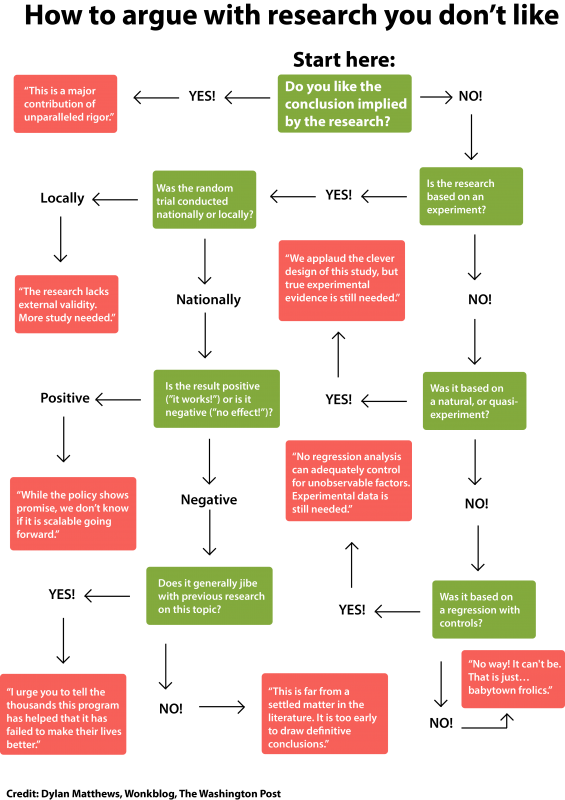
3.  Knowledge translation.  Even when results are disseminated, the time for new findings to be adopted into widespread clinical practice has lagged.  It has been reported that innovations can take 10 years to become commonly used.  Reasons include entrenched interest in the status quo (which does not only apply to for profit industry – evidence questioning the utility of a procedure, for example, may threaten the specialists who perform it), and sheer inertia.  Physicians are naturally skeptical, and often question the data when it does not conform to their pre-existing beliefs.  This figure illustrates the gauntlet a study must run before it can be accepted as the basis for a practice change.

Evidence-based medicine has the potential to reduce the excessive variation in practice that has been widely described.  The goal is not to eliminate variation, only to minimize unnecessary variation.  Different patients with the same disease will differ in their exact biological needs as well as their preferences; these differences must be understood and accounted for.  But their management should not be based on which part of the country a doctor happened to train in, or what year she graduated from medical school, or her Myers-Briggs personality type.  We expect the legal system to operate based on the facts – the medical system should do no less.

how_to_argue_with_studies1-565x800


Top Floor, Please

November 27, 2013

CHW LogoThanksgiving is one of the few holidays that, despite the emphasis on consuming to the point of gastric distress, has not lost its original significance of an occasion for giving thanks.  In our culture work we’ve used the “Mood Elevator” to depict the range of states of mind that can affect our thinking and actions:  at the very top of the elevator is “gratitude.”  It occupies that spot because the act of expressing gratitude reflects how utterly dependent we are on the people and world around us for everything that matters.  When we are grateful we are not alone.  If appreciation is the glue that holds an organization together, gratitude is the glue that holds us together.

For some time now, I have ended each day by thinking of three things I was grateful for that day.  It’s always easy to come up with one or two, though sometimes three is tough without cheating by falling back on overly used standbys (my wife, my children, Gilles’ custard).  But requiring three forces me to really consider the events, people, and interactions of the day and their value to me.  Here are some of the work-related things I’ve had on my list lately:

Colleagues who inspire me to excel, by their examples of dedication and commitment, clinical expertise, and inquisitive spirit.

A CHW leadership group that, in every way, truly exemplifies a team.

A work environment that is supportive, challenging, meaningful, and fun.

A short commute.

Those of you reading this can’t claim any credit for that last one, but as for the rest, I offer my thanks.  Upon leaving at the end of the day I sometimes think, to paraphrase a former minister of ours, “We haven’t just been to Children’s, we ARE Children’s.”  This organization is nothing more than the sum of all of us, and its success reflects on us all.