Who Am I To Judge? (Inspired by Pope Francis, part 1)

January 10, 2014

The medical student presented the case of an infant with nasal congestion for 2 days.  Based on the history and exam findings, it sounded like a baby with a mild cold.  “So why did they come to the ER?” I asked.  Perhaps assuming that, like so many emergency department veterans, I meant this as an indication of irritation with an abuse of the system, he replied, “I don’t know.  It does seem pretty unnecessary.”

“No,” I answered, “they have a reason.  Everyone on the planet has something better to do than to come to the Children’s Hospital ER.  If it doesn’t make sense to you, then you need to dig harder.  Our job is to find out why they are here and to make sure we address that reason.  Go back and see if you can find out more.”

The student returned a few minutes later, a bit exasperated. “I tried to get some more details, but couldn’t really sort it out.  The mom isn’t a great historian.”

“Actually,” I said, “the mother is the primary source.  We are the historians.  Never blame the patient or family for our inability to interpret the facts.”

I will never forget my experience as a fourth-year medical student.  On medicine rounds, we were discussing a patient who was not responding as expected to the prescribed treatment.  The attending physician asked me how I would explain that.  “I suppose he could be non-compliant with his medications,” I ventured.  The intern and senior resident nodded.  “Congratulations,” the attending said. “You’re clearly ready to be a doctor – your first reaction is to blame the patient.”  We were all embarrassed into a prolonged and uncomfortable silence.

People always have a reason for seeking our services.  Contrary to what some of the most jaded people say, it’s never to get a free popsicle or to watch our TV.  Neither is worth a 2-3 hour wait.  Sometimes it’s simply a matter of knowledge.  Most people who bring their child to an ER believe it’s an emergency.   Those of us with specific expertise and training can’t apply our standards to judge whether someone “needed” to come in.  (I hope my car mechanic doesn’t roll his eyes at me for bringing in my car for what turns out to be a benign noise, when I thought for sure the brakes were about to fail.)  In that case, a little education can go a long way toward helping both the child and the parents.

Other times, the physical complaints are not the real motivation for seeking help.  In the case of the baby with the cold, it turned out that the mother had run out of money and couldn’t afford to buy the bulb syringe that her doctor had recommended over the phone.  In my years of working in the emergency department, I’ve seen parents who were out of food for their child, who were victims of domestic violence, who were suffering from schizophrenia.  No one asks to be in those situations.  What they are asking for is help.  Living our value of purpose means finding out what our patients’ needs are and working to meet them.  Without judging. 


“Physician, heal thyself”

January 3, 2014

CHW LogoPolishing off the last of the Christmas cookies, and looking forward to the crowds of new members at the athletic club – must be New Year’s.  The well-intended but infrequently-kept resolutions we often make when the calendar turns seem to be disproportionately about health: dieting, exercise, de-stressing.  At the risk of hypocrisy (since I’ve never been big on the resolution-making myself), I’d like to suggest that we at Children’s take this opportunity to reflect on and make an effort to live up to our value of health this year.  A few specific thoughts:

1.  Check out the Healthy Rewards program.  Given the substantial savings you can earn on your health insurance, I’m always surprised that everyone doesn’t participate.  Sponsored by Employee Health and Wellness, this is program designed to encourage healthy habits including eating, exercise, and emotional well-being.  It’s not always rocket science, but sometimes a little reminder or friendly competition is what it takes to make a change.

2.  Wash your hands.  I’ve pontificated about this before, but I remain flabbergasted that we are anything less than 100% compliant.  Next time someone gets sick at work, remind them that a little hand sanitizer could have saved them a week of misery.

3.  Don’t be a martyr.  Speaking of being sick, remember that it is OK to be a patient sometimes.  Physicians in particular are notorious for refusing to succumb, powering through fever, nausea, and fatigue.  I suspect this may be shifting, as the previous machismo culture of Parris Island-style physician training yields to a more humane and realistic regimen, but it is still considered a sign of weakness to stay home when you are sick.  We owe it to ourselves, and to the patients and families we put at risk, to lay low when we are ill.

4.  Get moving.  Sitting has been shown to be a risk factor for all kinds of chronic illness and shorter life expectancy.  Perhaps the Zoo Interchange construction will get a few people to consider biking, walking, or taking the bus (and then walking to and from the bus stop) to work.  When the weather allows, try having some one-on-one meetings in the form of a walk around the block.  Take the stairs.

5.  Be at your best.


Generation Why

December 27, 2013

CHW LogoMy father used to make the rather ridiculous claim that children are always taller than their parents.  As patently laughable as that assertion is, others do not shy away from equally sweeping, and verifiably false, assertions about succeeding generations.  The most common tends to take the form of “kids have it so much easier than we do, and are so spoiled they don’t even appreciate how easy they have it.”  Each generation following the World War II “greatest generation” – the baby boomers, gen X, millenials – is purported to be increasingly self-centered and even narcissistic by the one preceding it.

In medicine, it’s not uncommon to hear “seasoned” (a.k.a. older) physicians (a category into which I, alas, fall) decry the ease of training in the era of resident work hour restrictions.  No doubt the life of a medical trainee is different, and yes, easier, now than 20+ years ago.  And I, too, share a certain nostalgia for the kind of camaraderie engendered by a shared survival of hardship, and for the nature of the doctor-patient relationship that may be unique to spending unsustainable hours together.  Perhaps that is the price one must pay for patient safety and a humane work environment.  But regardless of what one thinks of the merits of restricting work hours, we should not therefore assume that the current generation of students and trainees is any less motivated by commitment to healing than we were.  Choosing to value one’s health does not mean sacrificing purpose.

Indeed, there is some evidence that the millennial generation is, if anything, even more altruistic than ones before.  A recent report showed that “the no. 1 factor that young adults ages 21 to 31 wanted in a successful career was a sense of meaning.”  And the top choice for a place to work was a children’s hospital (St. Jude’s, to be precise)!  I see this in my own sons, 20 and 24 years old, who both made the decision to attend state university to avoid incurring debt, with the intention of entering some form of public service career.  Only one of them may have ended up taller than me, but both give the lie to the idea that altruism and service to humanity are waning characteristics.


Rethinking the Triple Aim

December 20, 2013

CHW Logo“Better care for patients, better health for the population, lower cost”: this is the Triple Aim of health care.  Last week at the Institute for Healthcare Improvement Annual National Forum, there was a riveting panel discussion on “Environmental Sustainability and the Triple Aim.”  Don Berwick opened with a reflection on the huge environmental impact of healthcare, especially hospitals.  A few examples:

  • Hospitals have 2.5 times the energy intensity and carbon dioxide emissions of other commercial buildings; they account for 8% of the nation’s energy use.
  • Hospitals generate a daily average of 26 pounds of waste per staffed bed – 5.2 billion (yes, billion) tons of waste annually.

You get the idea.  Berwick posed the question, how can we create better health when we are creating an unhealthy environment?  How can we drive cost down with so much waste?  He suggested that paying attention to environmental sustainability was essential to driving the Triple Aim.

Four panelists highlighted some of the successes in promoting environmentally sustainable healthcare.  Jeff Thompson, CEO of Gundersen Lutheran Health System in LaCrosse, talked about their successes in their goal of becoming the first carbon neutral hospital in the US.  Although some of that has been through innovations in using alternative energy sources such as geothermal and methane from biodigesters, Thompson noted “conservation should always be your first fuel.”  He cited a $2 million dollar investment in energy conservation and waste reduction that has yielded $1.3 million in savings every year.  That’s a pretty spectacular ROI.  Another speaker discussed the Healthier Hospitals Initiative, which currently includes over 700 facilities and aims to increase that to 2000 in the next few years.  The model is that of the improvement collaborative, with hospitals helping each other figure out how to improve their sustainability in several areas, including energy, food, chemicals, and waste.

The final speaker was an architect who discussed the progress of thinking from “green buildings,” which have a less harmful impact on the environment, to “living buildings,” which have zero impact, to “restorative buildings,” which actually provide a net benefit to the environment.  That sort of thinking is somewhat visionary and aspirational; getting there can seem daunting.  But if a journey of a thousand miles begins with a single step, think about what we could do easily that would get us started.  I came in to the office last weekend, and was startled at how many computers were running, monitors ablaze.  Why? Think of how many disposable cups we use, how many documents we print (with multiple copies for people who already have one, or aren’t even coming to the meeting), how many supplies we simply throw away unused.

The panelists were asked how, at a time when we all feel overwhelmed by what we are expected to do with shrinking resources, can a hospital possibly hope to add yet one more thing to the list of “blue chips.”  This is a fair question.  The canned, and somewhat disingenuous, responses were that this is different – it’s really, really important – and that it’s “easy” to piggyback this with other priorities.  But let’s face it, there does come a point where you truly can’t fit even one more sock into the suitcase – it just won’t close (or the zipper breaks).  The fascinating response came from a panelist who talked about their recycling initiative.  They were looking for a group to lead it, and over 50% of the employees volunteered, including many who had never stepped forward into a leadership opportunity before.  His conclusion is that there is a hunger for this sort of effort within our organizations, it’s something people recognize as a shortcoming in how health care operates, and that those people will come out of the woodwork to participate.  By inspiring action, it actually increases the pool of resources available.  Imagine not trying to cram that last sock in, but getting an additional suitcase.

This is a season that, at least in the US, is a virtual celebration of excess and waste.  Then January comes and we all resolve to do better.  When you are making your resolutions, maybe you can include some that will move us closer to environmental sustainability and the Triple Aim.  The kids in Wisconsin can’t be the healthiest in the country if at the same time we are making Wisconsin itself less healthy.


Ngiyabonga Mandela

December 13, 2013

CHW LogoHaving come of age when nuclear disarmament and apartheid were the issues roiling college campuses, it’s hard for me not to reflect on the passing of Nelson Mandela.  I still get a little teary thinking of the image of him walking out of prison, holding his wife’s hand, smiling and waving – an image that 10 years earlier, when I was watching protesters urge our university to divest from companies doing business with South Africa, I never thought I’d actually ever see.  Part of what I so admire is the way Mandela was able to balance two contradictory strains, and in doing so accomplish more than he ever could have using either approach alone.  He was the epitome of the versatile leader.

Mandela as conciliator.  Many have extolled his grace and magnanimity in victory over the apartheid regime.  Indeed, for many that is his defining characteristic.  One only needs to compare the violent conflicts in Zimbabwe, Algeria, or any of a host of other liberated colonies to the strikingly peaceful transition in South Africa.  It still defies belief that from the brutality that was apartheid, a multiethnic, multiracial society could emerge.  No one person can claim credit, but Mandela surely played an enormous role, though his leadership shadow – the shadow of integrity.  I don’t mean integrity in the sense of honesty and lack of corruption (though certainly he exemplified that, especially in contrast to the many other national liberation figures throughout the world who later succumbed to the temptations of power.)  I mean integrity in the sense of wholeness, or being true to oneself and others.  Mandela expected – demanded – to be treated as the equal of anyone else, even by his jailers and tormentors, but delivered no less himself.  During his many years in prison on Robben Island, he learned to speak Afrikaans, and encouraged his fellow Xhosa and Zulu-speaking political prisoners to do the same, so he could interact with his jailers as fellow humans.  This led to a mutual respect that paved the way for fruitful negotiation.  Mandela believed in the inherent worth and dignity of all people, neither allowing it to be taken from him, nor withholding it from others.

Mandela as fighter.  While the peaceful end of apartheid has dominated the remembrances, we can’t forget that it was the culmination of a decades-long and at times violent struggle, and Mandela was an advocate for and leader of that struggle.  His imprisonment was certainly a moral wrong, but he was not actually innocent.  After all, he was dedicated to overthrowing an unjust regime, openly so.  He never renounced or lost sight of that purpose.  He just remained flexible in his tactics.  Mandela didn’t learn Afrikaans to support the regime, but as a tool to subvert it.  He is revered as a pragmatist.  Pragmatism, however, is not an end, but a means.  Importantly, ending apartheid was only the first of many goals Mandela and his comrades embraced.  Once majority-rule democracy was established, Mandela fought for the welfare of those people who had been marginalized.  The post-apartheid constitution that Mandela helped craft enshrines a number of basic rights, including a right to education and to health care (something we could perhaps learn from).

Nelson Mandela was a man of great integrity and great sense of purpose.  Both are necessary to achieve great success.  As his example shows, even the most seemingly intractable problems can yield in the face of stubborn conviction coupled with an equally stubborn acceptance of the worth and dignity of each person, both ourselves and those who oppose us.

Here is one of my favorite songs, a musical tribute to Nelson Rolihlahla Mandela. 


Just The Facts

December 6, 2013

CHW LogoIt seemed so easy when Sgt. Joe Friday said it on Dragnet.  Why do we have so much difficulty in practicing medicine that way, based on evidence, on facts?  Here are some of the barriers, as I see them.

1.   Evidence generation.  This seems obvious, but evidence-based practices requires, well, evidence.  In many fields, especially pediatrics, there is a serious lack of evidence to support even treatments that are widely used.  One issue is lack of funding.  NIH funding, even before it began to decline due to the federal budget sequester, often goes preferentially to basic science rather than clinical trials, and to adult trials that address common, high-impact conditions.  While regulations about inclusion of children in research, the Better Pharmaceuticals for Children Act, and FDA incentives for industry to do perform pediatric trials to support patent extension have helped, funding for pediatric patient-oriented research continues to lag.  Pediatric trials are also difficult to conduct.  Many childhood diseases are sufficiently rare that they can only be studied in the context of multicenter trials, which are logistically challenging and more expensive to conduct (typically exceeding the level requiring additional scrutiny at NIH).

Nevertheless, generating evidence is absolutely critical.  When we do systematically evaluate treatments, as a study in Mayo Clinic Proceedings shows, the results often fail to support established practices.  Of 363 comparative trials of established practice reviewed, 40% showed that a standard practice was ineffective or harmful, 38% reaffirmed established practice, and the rest were inconclusive.

2.  Evidence dissemination.  Even when studies are done to critically evaluate a diagnostic test or treatment, the results may not be widely disseminated.   Publication bias – the tendency for authors to prefer to submit, or for journals to prefer to publish, studies with positive results, has been well described.   The reasons may include profit motive (for industry sponsored trials), legitimate concerns about negative results from underpowered studies, or sheer laziness.   The requirements by major journals to register trials before they begin as a condition for publication was supposed to help minimize publication bias, or at least enable  its detection.  But a study in PLoS found that only 46% of reportedly completed trials listed in ClinicalTrials.gov had been published.  Publication rates were lowest for industry sponsored studies (40%), followed by 47% for government funded studies and 56% for non-government, non-industry supported studies.

And of course, there is the sheer volume of stuff to read.  Medical and scientific journals have exploded in number; it is nearly impossible for a practicing provider to keep up with the literature.

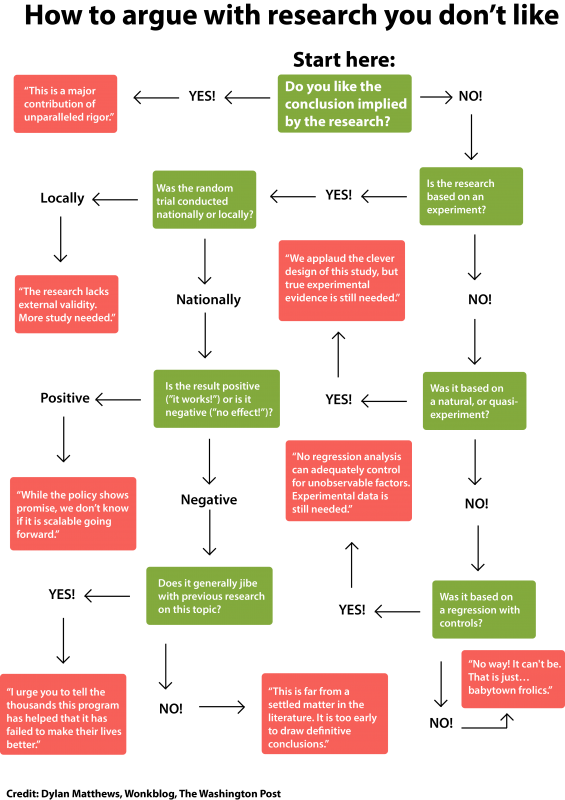
3.  Knowledge translation.  Even when results are disseminated, the time for new findings to be adopted into widespread clinical practice has lagged.  It has been reported that innovations can take 10 years to become commonly used.  Reasons include entrenched interest in the status quo (which does not only apply to for profit industry – evidence questioning the utility of a procedure, for example, may threaten the specialists who perform it), and sheer inertia.  Physicians are naturally skeptical, and often question the data when it does not conform to their pre-existing beliefs.  This figure illustrates the gauntlet a study must run before it can be accepted as the basis for a practice change.

Evidence-based medicine has the potential to reduce the excessive variation in practice that has been widely described.  The goal is not to eliminate variation, only to minimize unnecessary variation.  Different patients with the same disease will differ in their exact biological needs as well as their preferences; these differences must be understood and accounted for.  But their management should not be based on which part of the country a doctor happened to train in, or what year she graduated from medical school, or her Myers-Briggs personality type.  We expect the legal system to operate based on the facts – the medical system should do no less.

how_to_argue_with_studies1-565x800


Top Floor, Please

November 27, 2013

CHW LogoThanksgiving is one of the few holidays that, despite the emphasis on consuming to the point of gastric distress, has not lost its original significance of an occasion for giving thanks.  In our culture work we’ve used the “Mood Elevator” to depict the range of states of mind that can affect our thinking and actions:  at the very top of the elevator is “gratitude.”  It occupies that spot because the act of expressing gratitude reflects how utterly dependent we are on the people and world around us for everything that matters.  When we are grateful we are not alone.  If appreciation is the glue that holds an organization together, gratitude is the glue that holds us together.

For some time now, I have ended each day by thinking of three things I was grateful for that day.  It’s always easy to come up with one or two, though sometimes three is tough without cheating by falling back on overly used standbys (my wife, my children, Gilles’ custard).  But requiring three forces me to really consider the events, people, and interactions of the day and their value to me.  Here are some of the work-related things I’ve had on my list lately:

Colleagues who inspire me to excel, by their examples of dedication and commitment, clinical expertise, and inquisitive spirit.

A CHW leadership group that, in every way, truly exemplifies a team.

A work environment that is supportive, challenging, meaningful, and fun.

A short commute.

Those of you reading this can’t claim any credit for that last one, but as for the rest, I offer my thanks.  Upon leaving at the end of the day I sometimes think, to paraphrase a former minister of ours, “We haven’t just been to Children’s, we ARE Children’s.”  This organization is nothing more than the sum of all of us, and its success reflects on us all.


Beam Me Up

November 22, 2013

CHW Logo

Here’s a statement that could be a set up for a high school debate team or one of those shows on cable news: “The US has the best healthcare in the world.”  I have debated this with myself many times.  The pro argument emphasizes the role of research and technology, the availability of tests and treatments that may have seemed like science fiction not too long ago.  But I usually land on the con side, thinking of our dismal overall statistics on life expectancy, child mortality and health status, coverage, and costs.

Sometimes, though, anecdotes trump statistics, as I learned the other day when I had the opportunity to spend the morning rounding in our operating suite.  First, I observed the set up in OR 3 for a Norwood procedure, a now standard operation for an otherwise fatal congenital heart condition, hypoplastic left heart syndrome.  They were getting a heart-lung bypass machine ready for a 1 week old infant.  Although it is done in many centers now, our hospital has one of the highest volumes, and literally some of the best outcomes in the world.  For a condition that was once uniformly fatal – standard treatment at most centers when I was a resident was hospice  – today at Children’s Hospital of Wisconsin about 90% of children survive.

Next, I went to OR 6, where an EXIT procedure was being performed.  EXIT stands for ex utero intrapartum treatment, and it’s an acronym that actually has some intrinsic meaning.  It was developed for when a mother is carrying an infant with some kind of anomaly (in this case, a giant cyst in the neck) that would make it impossible for the infant to breathe after birth.  A Caesarean section is done, but only the baby’s head and shoulders are brought out – a partial exit, if you will.  A team of ENT and general surgeons then works to establish the baby’s airway before delivering the rest of the baby.  Technically, the baby is being operated on before it is actually born (the moment of birth is when the cord is cut), and the mom serves as a type of heart-lung bypass machine.  This is a highly complex, technically difficult procedure, requiring enormous coordination (there were at least 20 people involved), and only done at a handful of institutions, including ours.  Even at that, this is only the fourth one we’ve ever done.

But wait, not done yet!  As I was leaving the successful EXIT procedure, I passed OR 8, where a team of neurosurgeons was doing our first ever, apparently oxymoronic  “minimally invasive neurosurgery,”  to treat a young child with a brain tumor that might otherwise have been inoperable.  Using a specialized guidance device in the OR, the neurosurgeon placed a laser-tipped catheter into the child’s brain.  The patient is then moved to MRI, where the tumor can be zapped with the laser.  MRI guidance allows the surgeon to see exactly where the laser is, and to monitor the temperature of the surrounding tissue so that only the tumor is targeted.  And get this: at the end of the procedure, the catheter is removed, the wound in the scalp is closed with a single stitch, and the patient can go home within 1-2 days.  After brain tumor surgery!!  This isn’t exactly Dr. Leonard McCoy with a tricorder, but it’s darn close.

Three children who when I was in training would almost certainly have died – three families left with an unfillable hole – who instead will all go on to soil thousands of diapers, enjoy kindergarten, create adolescent havoc, and perhaps have their own children.  On the one hand, this was thanks to Star Trek-type technology that really highlights our value of innovation.  Yet I was also struck by just how routine, how normal it all seemed.  A casual observer might not have been able to appreciate how groundbreaking some of this was, because the physicians and staff were just so – I guess “controlled” is maybe the best word.

I, on the other hand, was floored.  Three children saved from fate.  Yes, we still have too many children who do suffer or die, many from things that are easily prevented.  And the kinds of things I witnessed are very expensive; having them is wonderful, but if only a small handful of those who need them can get them, that’s not good enough.  Yet the look of hope and joyful anticipation I saw on the face of the mother about to undergo the EXIT procedure forced me to acknowledge that the answer to the question of whether the US has the best healthcare in the world is an ambiguous one.  The debate goes on.


Back to Normal

November 15, 2013

CHW Logo

I now know that the five most disquieting words in the English language are “This is not a drill.”

As some of you undoubtedly know from national news coverage, we had a shooting at Children’s Hospital of Wisconsin yesterday.  Police, responding to a report of a visitor who was armed and dangerous, shot the suspect (not fatally) and gained control of the situation.  From around noon until 2 pm, the hospital was in a lockdown situation.  During that time, the other leaders and I were in a command center; much of our time since then has been spent in analyzing what happened and our response, and most important, in supporting all of our patient families and staff that were affected.

Thanks to our planning and procedures, and the outstanding work of our staff and law enforcement, no patients, families, or hospital staff were injured.  In retrospect, things went as well as one could reasonably expect, maybe even better.  I mean let’s face it, education and drills notwithstanding, there is no way to really rehearse for the real thing.  Adrenaline and neurotransmitters are running rampant, time becomes completely elastic, people get hungry.

You might think an actual situation like this would be less choreographed, more chaotic than the drills.  (We actually had an active shooter drill within the last couple of months.  It was kind of boring.)  Although I was never in danger myself, it was certainly nerve-wracking.  And going around to all the care areas after, behind the modest words I could sense that many people had been frankly frightened and concerned for others.  But what I saw everywhere was not chaos, but calm.  Even when communications were spotty, or procedures unclear, there was no panic.  It was almost surreal.  At the time, I was mostly relieved and appreciative (and a bit hungry).  I chalked it up to the supreme professionalism of the people I work with.

But reflecting now after 24 hours, that wasn’t quite it.  Not that there wasn’t extraordinary professionalism, it’s just that that isn’t enough.  What I saw was skilled professionals living out our values of being At Our Best:

1.  Purpose – We act in the service of patients and their families.

The nurses who shepherded families to safe locations in the clinics, and the nurses who stayed with the patients who couldn’t be moved.

The code team that despite the lockdown responded to not one, but four different emergency (“code”) situations, including to assist the man who was shot.

2.  Integrity – We build confidence and trust in all interactions.

Althea, the administrator on call who took charge as the incident commander and calmly directed activities.

The CHW security staff who  worked with four different law enforcement agencies to control access, provide escort to personnel who needed to move about, and provide a sense of confidence that all was under control.

3.  Collaboration – We work together to care for children and families.

The administrative team in the command center who during the incident and in the hours after worked together to return the hospital to normal.

The off duty security officer who happened to be in the hospital with his child for an appointment, who stepped in to help.  And the clinic staff who watched his child in the meantime.

4.  Innovation – We commit to breakthrough solutions with continuous learning.

The many people who made creative suggestions of ways we can make our response even better should we ever need to in the future.

The communications team who use various means to get information out via email, Intranet, Twitter, etc. to try to keep people informed.

5.  Health – We are at our best.

The behavioral health providers who canceled clinics to be available as a resource for staff, along with social workers, human resources, etc.

The environmental staff who within minutes of the “all clear” were out making sure our facility was clean and ready.

Every single person who stopped to ask someone else if they were OK and if they needed anything.

As the swarm of media vans and news helicopters attests, this is the kind of incident that draws a lot of attention.  News is, by definition, what doesn’t happen every day – it’s what’s not normal.  Our values, though, are a constant.  Not terribly newsworthy.  But as the attention fades, as we get back to our routine, I’m reflecting on how grateful I am to be part of an organization that lists and lives those values.  That’s our normal.


Stewardship

November 8, 2013

CHW Logo

When asked what I do, I still reply “I’m a pediatric emergency physician,” but honestly, these days I’m mostly an administrator.  I’m a suit.  I deal with things like contracting and billing, staff productivity measures, even surgical inventory management.  {That’s a thing?}  Which sounds, frankly, less noble {and less “sexy”} than the first answer.  So I want to try on a new answer:  I’m a steward.

Stewardship is “the activity or job of protecting and being responsible for something; the careful and responsible management of something entrusted to one’s care.”  The term is often applied to finance and natural resources, but has also been used to refer to pastoral care.  I like this definition because it emphasizes not only the actions of making careful decisions and avoiding waste.  It also encompasses the special relationship between the steward and the resources being managed, the elements of trust, of accountability.  All healthcare providers are, in essence, stewards – we are entrusted to care for our patients and to manage their health.  But even those who wear scrubs rather than suits to work are stewards in the business sense.

I realize that referring to medicine as a business gives many healthcare providers hives.  But the fact is, while I believe medicine is more than a business, it is still a business.  If you are wondering if what we do is a business, ask yourself, “Do we charge money for what we do?”  The answer, of course, is “Hell, yeah.”  Albert Schweitzer may not have been in the business of medicine, but the rest of us are.

Stewardship is critical on two levels.  The first is the organizational one.  Many of us are in the non-profit sector of healthcare.  The gap between the revenue we get for the services we provide and the expense of providing those services {salaries, supplies, mortgage, utilities, etc.}, is our margin, which we hope is a positive number.  {These days, accountants don’t use red ink for bad numbers, they use parentheses – parentheses are bad.  That’s why I’m using brackets instead.)  The margin doesn’t go to executive bonuses, or to pay off shareholders.  That extra revenue is what we have available for two things.  It supports those parts of our mission that we don’t get paid for {charity care, injury and illness prevention, community engagement, research and education}.  It’s also what we rely on to invest in new and replacement equipment, facilities, and programs.  It is a cliché to say “No margin, no mission,” but that doesn’t make it any less true.

Our hospital and health system is a tremendous asset to our community, one that has been entrusted to us.  Our vision is that the children in Wisconsin will be the healthiest in the nation, and I truly believe that our community would be less healthy if we were not here.  We are challenged by many changes in the healthcare environment.  Spending on healthcare has reached unsustainable levels, and while it is leveling off, we will continue to get paid less for what we do.   Which is why all of us need to be good stewards.  By focusing on making what we do cost less, we will ensure that the margin that supports our mission can be sustained.

We also must be good financial stewards for the sake of our individual patients and families.  One of the most striking effects so far of the Affordable Care Act is the acceleration of employer sponsored consumer-directed plans, also known as high deductible health plans, in response to the ACA’s tax on so-called “Cadillac” health plans starting in 2018.  While only 4% of employer health plans were HDHPs in 2006, they were over 20% in 2012.  For 2014, over 40% of employees in our system selected an HDHP {including me}.  Ironically, this is a solution that has long been promoted by free-market health economists.  The idea is that by having patients have more “skin in the game,”  in the form of high deductibles and hefty cost-sharing, they will shop more carefully for health care services.  While the several thousand dollars of out of pocket expenses are going to make me think twice about what services I seek and where, for many of us they are an inconvenience.  But for many of our patients and families, it’s more than that.  A parent may be deciding whether to have their child’s tonsils out or save for college.  It may be a choice of filling a prescription or having a meal.  We may find the idea distasteful, but it’s reality.  If we don’t control our costs, families will either be forced to go elsewhere, or go without.

Our hospital, our patients – these are things that have been entrusted to our care.  We say “kids deserve the best.”  Let’s be good stewards, so they can have it.