“Hands That Heal, Hearts That Care”

May 11, 2016

CHW LogoOur chief nursing officer used this phrase to summarize the profession of nursing at an event for Nurses’ Week, a time to celebrate that profession and the individual nurses who practice it.  In honor of the occasion this year, I have invited a guest blogger – our patients’ families!  Here is just a very small sample of the comments about our nurses from our patient and family experience surveys (names removed for privacy).

  • After rushing to the ER and getting admitted right away, we had an amazing nurse who I will never forget, his name is XXX! He cared for my son so kindly, kept me calm and tried to keep my son comfortable while providing care – although he is too young to understand Nurses and Doctors are the good people trying to help… We talked about my son’s favorite things, his family and his kids. After leaving the room XXX later came back with a Mickey Mouse toy (his favorite character lately) for my son. He told me he holds onto toys until he feels that a child needs it after a rough night in the ER. In that moment I was thankful for the pick me up and an exceptional nurse. Thank you for calming me and providing compassionate care for my son in that moment, you’re an amazing Nurse!
  • This was our best hospital stay yet. Everyone worked as a team & we felt included.  We felt like everyone listened to us.  The nurses treated our daughter like a child, including her and allowing her to make choices & be heard.  We really appreciated the care!
  • The ER staff were ALL absolutely amazing! Nurse XXX on W-10 was the BEST!  She worked all night and stayed another 4 hours and took awesome care of our son.  She spent time talking to him about things he loves.  She spent 15-20 min talking and sharing with him.  Priceless!!
  • As we left the hospital, my son said I feel like we are leaving good friends behind. That is how connected he became to the wonderful nurses who took care of him.  Children’s Hospital became a haven for us in the midst of his scary medical condition.  I cannot thank the staff enough!
  • There was a nurse in training. I wish I could remember her name, who came in on our last day, she sat & rocked and sang to my baby for several hours so I could rest.  She was very kind & I wish she knew how thankful I was for her time & gentleness with my son.
  • Every person who entered our son’s room was an angel of healing. They made a very scary situation manageable + helped us to find peace + healing.  They recognized that our whole family was part of our healing team, and we went home with a healthy child.  For that we will be extremely grateful.
  • No parent wants to see their child go through surgery, but w/ the awesome staff we had & of course all our prayers we were truly relaxed & extremely grateful! The nurses were beyond WONDERFUL!  There were two nurses who stuck out to me during my daughter’s stay – ones name was XXX & I wish I remembered the young RN who never stopped smiling or asking how we were doing or if we needed anything!
  • I just have to say that the nurses were amazing and caring and put you at ease during a very scary time. We were never left hanging and they always kept us informed, amazing care!!
  • Two nurses on 10 West deserve to be acknowledged & credited for their excellent care. They should get employee or nurse of the month awards.  They are so compassionate about their jobs & the care they give.  Absolutely best experience of our lives.  Thank you Children’s Hospital!
  • Very impressed with the level of care provided and quite impressed, truly, with the obvious strong line of communication amongst all caregivers. I’ve never seen this level of effective and efficient communication at any care facility, ever!  Hats off to your entire staff.
  • My son’s nurse XXX was amazing. I always looked forward to the evening shift when she showed up.  Evenings were hard as the rest of my family had to leave.  She made my evenings a lot better.

Hmm, communication, calming, caring, compassion.  That pretty much sums up Children’s nurses!  They are the best – because kids deserve the best.


What’s New?

May 6, 2016

CHW LogoIt’s usually a throwaway question, the answer being “Not much?  How about with you?”  But after spending the last few days at the annual Pediatric Academic Societies meeting, I’d answer “A ton!”.  Besides renewing a bit of a connection with my clinical and academic roots, I heard a lot that reinforced our value of innovation, including over 100 presentations by Children’s Hospital of Wisconsin and Medical College of Wisconsin faculty, trainees, and staff.  Over the 25 years I have been involved with this meeting, it has continued to evolve for the better.  A great deal of what is presented now falls under the rubric of quality improvement, demonstrating that we can always find ways to provide care that leads to better outcomes, lower cost, and better experience, and that we are always getting better at getting better.  I left with a long list of new ideas we can consider at Children’s.  And some of my colleagues learned from what we are doing and shared at the meeting.

I also realized that good ideas don’t matter if they aren’t put into action, and that takes advocacy.  Being with thousands of pediatric providers is a sure fire way to renew one’s sense of purpose.  A particularly inspirational moment was a talk by Dr. Mona Hanna-Attisha, the pediatrician who helped uncover the tragedy of lead in the water in Flint, Michigan.  Spurred by the needs of her patients and families, she did the research to demonstrate the reality that Flint’s children were being poisoned, and that it was due to lead in the water.  Then she advocated for action to fix it.  Neither was easy.  Fighting attacks from the authorities who were conspiring to hide the facts, Dr. Hanna-Attisha relentlessly pursued two things – truth, and justice.  All in the interest of improving the health of children.

One thing I took from it is that we are all advocates for children.  Advocacy is simply a call for action.  Those actions can range from public policies to address the social determinants of health, to better integration of children into school after a heart transplant, to a reduction in unnecessary X-rays in infants with bronchiolitis, to greater family and nursing involvement in patient rounds – all ideas presented by the CHW team, by the way.  Making a difference means turning those innovations into practice and policy, at all levels.  Advocacy is where the rubber of innovation hits the road to having the healthiest kids.


Administrative Professionals Week

April 26, 2016

CHW Logo“Those who can, do; those who can’t, teach.”  That quote always ticks off teachers (and rightfully so.)  But the slur was actually aimed at bureaucrats: the complete quote ends with “and those who can do neither administer.”  As someone who has been both a teacher and an administrator, I naturally take exception to the sentiment.  Like most things, administration is inherently neither good or bad; it can be done well or poorly.  Increasingly I’ve come to understand the skills necessary for management.  And I appreciate those who master those skills.

Fortunately, there is a cadre of folks who dedicate themselves to mastering administration –  the administrative professionals.  In most organizations, they are the people who know how to get things done.  Without fanfare, and with little recognition, they ensure smooth operations, everything from juggling complex calendars to ensuring timely and effective communication, keeping everyone on track and on time (and in many cases fed).

The word “administer” appeared in English in the 14th century.  It derives from the Latin “ministrare,” the same root as “minister,” meaning to serve.  And administration is about service.  For us, it is service not only to those who work at Children’s, but ultimately to those patients and families who benefit from a well-run hospital and health system.

So thank you to all those administrative professionals at Children’s.  I appreciate the myriad ways you make my job easier, and help our organization get closer to our vision that Wisconsin’s kids will be the healthiest in the country.  You can take pride in your role in that.  You not only can, you serve.


Bustainability

April 22, 2016

CHW LogoGrowing up in New York, I both enjoyed and took for granted public transportation.  My friends and I would often take the train into the city, and use the subway to get around pretty effortlessly.  To a suburban adolescent, public transit meant freedom.  But to society at large, it means sustainability.subway

That word gets thrown around a lot, especially around Earth Day (April 22).  The idea of wanting to pass along what we have to our children and future generations is an ancient one.  What is different now is the realization that even vast resources are finite, and the size and scope of human activity has reached the point where it threatens our ability to do so.  We often think of sustainability in environmental terms: reducing the negative impact of human activities on nature.  But the concept of sustainability also includes social and economic dimensions.  What we ultimately want is for our community – which is a local ecology of people and environment – to thrive both now and into the future.

There are many threats to sustainability, ranging from pollution and loss of open space to segregation and the cycle of poverty.  While there are many efforts to address individual challenges, some of the problems are so interlinked that they require a more comprehensive approach, such as regional planning.  It is exciting to see that in our little corner of the world, such planning efforts are underway by the MRMC (Milwaukee Regional Medical Campus, where Children’s Hospital of Wisconsin is located) and the city of Wauwatosa.  One emerging component is bus rapid transit (BRT), which has the potential to address all three components of sustainability.

BRT is a modified bus system, using existing city streets.  Buses travel in dedicated lanes, make fewer stops, use pre-paid tickets, and have the ability to modify traffic signals as they approach, all intended to decrease travel time and increase predictability.  (That’s the “rapid” part.  Contrary to some concerns among residents, they are not giant vehicles screaming down the local streets, just regular buses moving at regular speed.) It’s a way of having many of the advantages of rail at a lower cost.  One of the potential benefits include fewer cars on the road, meaning lower emissions, less traffic, and fewer acres and dollars consumed to create parking. (One spot in a parking garage costs approximately $20,000 to build.) But it also increases the transportation options making the BRT destinations more attractive and accessible to diverse travelers.  This includes those for whom car travel is economically or otherwise unfeasible, as well as those (increasingly including the millennial generation) who choose not to drive.  (Increasingly I put myself in the latter group.  Not only do I bike to work year-round, but Lynn and I may be the only people we know to have taken the Milwaukee County bus to the black-tie Swan Ball at the Pfister Hotel years ago.)

bus

Places like the MRMC – like the mid-20th century vintage campuses of corporate giants such as General Motors and IBM, and the more soulless late-20th century office parks that litter the suburbs of every American city of any size – are important economic engines for our region.  But to be sustainable, they need to not only have a lower water and carbon footprint, they must be better woven into the fabric of the community.  We need to become more of a campus and less of a fortress.  We need to become a destination, and a welcoming one at that.  BRT would be a step in the right direction.  One my millennial sons would undoubtedly use.

PHOTO BY NICK CHRISTENSEN / METRO NEWS In Las Vegas, the MAX is a bus – a bus rapid transit line opened in 2004.


“Where there is dirt there is love.”

March 23, 2016

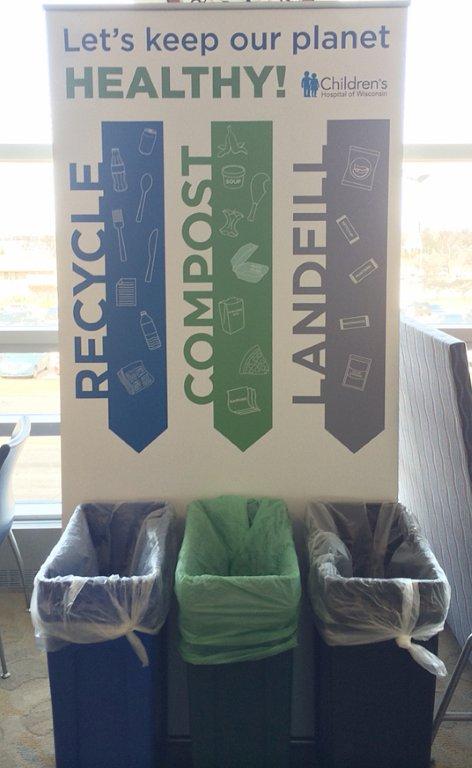
Composting Recycle Landfill SignCHW LogoSo said my niece Alice as we were planting a tree in memory of her cousin, Finley. Now I’m not one to argue with a 4 year-old with a romantic streak, but I’d put it differently, if more prosaically: where there is dirt there is life. No dirt, no plants, no food – no us. But dirt gets little respect.  Until our language loosened up in the 1960s, “dirty” was the 4-letter modifier of choice: dirty liar, dirty rat, dirty dog, dirty deed.  Today the word seems quite mild, even quaint, but there is still a huge phobia of dirt.

Dirt – the kind you dig in – is nothing more than decayed organic matter.  Leaves fall in autumn, and by the next year they have been miraculously transformed into a rich soil in which the tree’s seeds can germinate and grow.  All kinds of organic material can decompose into soil, including food scraps and paper.  By composting, organic waste becomes dirt; what is useless becomes useful.  As the saying goes, one person’s trash is another’s treasure.

Which is why I am excited that Children’s Hospital of Wisconsin just became the first hospital in the Milwaukee area to begin composting its food waste.  Starting in our Seven Sisters café, we will collect unused and uneaten food, paper goods, and compostable food containers.  Our partner is Compost Crusader, a local company that picks up compostable waste and turns it into fertile soil.  It’s a perfect example of the triple bottom line: less waste, better health, lower cost.  Here’s why:

  • When organic matter goes to the landfill, it decomposes anaerobically, generating methane, which is a greenhouse gas 20 times more potent than carbon dioxide. Composting avoids this major contributor to climate change
  • When compost is applied to gardens and farms it reduces or eliminates the need for chemical fertilizers, which are expensive and environmentally hazardous
  • In part because the compost product can be sold, having food waste removed separately for composting is less expensive than including it in our usual waste stream. At CHW estimate we will save several thousand dollars annually.

Americans generate an estimated 133 billion pounds of food waste easy year.  (No, that’s not a typo.) This is almost 1/3 of all the food produced. Composting can have an enormous positive impact not only on our environment, but ultimately on our health.  So far with our trial we are on track to compost over 10 tons of food waste per year.

Undoubtedly some people will be a bit squeamish about something as dirty-sounding as composting.  But think about it: how much worse is your uneaten pizza crust or unpopped corn kernels in a separate bin than mixed in with everything else?  I’ve been composting at home for decades and if anything, it’s tidier than having unsorted trash.

So when you see the new compost bins and signs, go ahead and pitch in!  We’re starting in one area to get out the kinks, with hopes to eventually expand to all of our food service areas.  It’s better for the earth, better for Children’s, and ultimately better for children.  As Alice would say, go ahead and create some love.


Progress on Disparities

March 9, 2016

CHW LogoDespite its resemblance to a reality TV show, one positive effect of this year’s presidential campaign is that the issue of inequality in our society has been brought to the forefront.  In addition to economic polarization, there are persisting disparities in both health outcomes and the important determinants of health, especially for children and especially in urban areas like Milwaukee.  The vision of the children in Wisconsin being the healthiest in the nation can seem unattainable in the face of such gaps.  So I was especially heartened by a series of articles in the journal Pediatrics from the first few months of 2016, each providing a glimmer of hope that we may be inching closer to the goal of health equity for all children:

  • The prevalence of asthma in the US, which doubled from 1980 to 1995 and continued to increase, with widening racial disparities, has flattened, and the racial difference stopped growing. Moreover, this is being driven primarily by a plateau in the rate of asthma among black children.
  • A study of cigarette taxes over time across the US shows that higher cigarette taxes and prices are associated with a decline in infant mortality rates. This benefit was strongest among African-American infants. (Of note, Wisconsin has one of the highest cigarette taxes in the nation, 11th highest at $2.52 per pack.  New York is the highest at $4.25, while the lowest is Missouri at $0.17.)
  • Human papilloma virus (HPV), which causes genital warts and also accounts for the majority of cases of cervical cancer, is now preventable by a vaccine. Although there has been considerable controversy about the vaccine, there has been a 64% decrease in HPV prevalence in 14-19 year old girls following its introduction.  Since HPV disproportionately affects men and women of color, this benefit will be especially great for minorities.  (The HeLa cell line, now widely used in medical research, was obtained unknowingly from a black woman who was treated for and succumbed to cervical cancer at Johns Hopkins in the 1950s.   The Immortal Life of Henrietta Lacks recounts her story and is a fascinating read.)
  • The lasting consequences of adverse childhood events – ranging from poverty to violence to family instability – are increasingly recognized, but little is known about how to mitigate the effects. An intervention among poor minority middle school youth in Baltimore schools demonstrated that mindfulness-based stress reduction techniques led to significant improvements in psychological and behavioral outcomes: less depression, somatization, negative coping, and post-traumatic stress symptoms.

There’s still a lot of work to do to erase the pervasive disparities in our community, but it’s great to get some encouraging news from time to time.


Superbugs

February 29, 2016

CHW LogoThe Milwaukee harbor looked especially beautiful from the air as I flew above it today, bright blue and sparkling on this uncharacteristically warm and sunny February day.  Unfortunately, my enjoyment of it was marred by the knowledge that the harbor contained a particularly unsavory collection of bacteria – the kind of antibiotic-resistant “superbugs” increasingly causing hard-to-treat infections.  A recent study revealed that bacteria in water samples from that harbor had extremely high rates of resistance to multiple antibiotics.  In fact, bacteria in the harbor were far more likely to be multiply drug resistant than bacteria obtained from sewage samples or from hospitalized patients!  It turns out that antibiotics that get into the water – from being excreted in the urine of patients taking them, from unused medications being flushed down the drain, from agricultural runoff from farms that use antibiotics in animal feed – concentrate in the lake sediment.  This persistence of low levels of antibiotics provides the sort of selective pressure that, through natural selection, leads to the emergence of resistant organisms.

This is a striking example of the way our health care system, designed to heal disease and promote health, can have unintended negative consequences.  Overuse of antibiotics and other antimicrobial compounds (the kinds found in “germ killing” soaps, lotions, fabrics, etc.), and their improper disposal, is paradoxically creating a reservoir of bacteria that will be increasingly hard to destroy.  It’s like an antimicrobial arms race.  And the bacteria are winning.

Our value of health calls on us not only to take care of ourselves, but to think about the impact of what we do on the health of the environment.  After all, environmental factors have a bigger impact on our health than medical care does.   The antibiotic stewardship program at Children’s Hospital of Wisconsin promotes more appropriate antibiotic prescribing.  As individuals, we can also only take (or prescribe) antibiotics when truly necessary.  As tempting as it may be to flush that expired bottle of cefdinir down the toilet, take it to a medication collection station instead.  Consider purchasing antibiotic-free meat and dairy products.  The next time you drive by and admire the beauty of Lake Michigan, consider whether you are inadvertently helping create monsters lurking on the bottom.


Kids Will Be Kids

February 12, 2016

CHW Logo

In many ways, childhood is being extended in the contemporary West.  Until the 1960s, age 18 was considered the beginning of adulthood.  Now, the average age of first marriage continues to rise, teens are encouraged to take a “gap year” before starting college, young people are permitted to be covered by their parents’ health insurance regardless of whether they are considered “dependents,”  new science shows how brain development isn’t really complete until the mid-20s.  Yet at the other end of the age spectrum, childhood is being truncated.

A recent article in The Atlantic by Erika Christakis documents how kindergarten and even pre-school is becoming more focused on drilling and testing, at the expense of the kind of creative play and exploratory building of social, emotional, and cognitive skills that go along with it.  The pendulum has swung, as she describes it, “between a ‘protected’ childhood and a ‘prepared’ one.”  Christakis argues that this is actually counterproductive.  She cites research showing that such highly structured “school readiness” programs – built around direct instruction and repetitive drilling – actually led to worse performance in later grades.

Moreover, the long-term effects of placing such demands on such young children remains unclear.  According to a New York Times story about the Success Academy Charter School in Brooklyn, teachers are encouraged to motivate students as young as kindergarten by fear.  One teacher was video-recorded ripping a first grade girl’s paper in half, putting her in time out, and berating her in front of the class because she was unprepared to discuss a math problem.  Another teacher made a kindergartener who stumbled on a math problem cry so hard she vomited.

This is reminiscent of the relentless focus on academics and performance that characterizes the “tiger mother” approach to child rearing.  The sacrifice of “frivolous” activities is said to be worth the high performance of the resulting child prodigies.  Yet studies show that true creativity is engendered not by hours of math problems and violin practice, but by sufficient unstructuredness during childhood.  For example, in one study, the most highly creative teens in a school (top 5% by teacher rating) were compared with their less creative peers.  The ordinary children had more than 6 times the number of household rules as the most creative ones.  Repetition and drilling may foster skills, but not learning.

Kids have plenty of time to be adults.  When they’re young, let them be kids.


More Recess @AmerAcadPeds @ChildHealthUSA @childhealthwi

January 29, 2016

CHW LogoWe’ve all heard the adage “All work and no play makes Jack a dull boy.”  It turns out that it also makes him obese, interferes with his learning, increases his cardiovascular risk, and ruins his vision.  Yet American children continue to face pressures to work more and play less.

American children have the 4th highest number of classroom hours in the world, yet some of the shortest recess.  Moreover, with the increased focus on standardized testing and “accountability,” the school year has gotten longer and recreational time has decreased. The pressure on so-called failing schools to improve their test scores has led to socioeconomic disparities as well.  In Seattle, for example, schools in higher income neighborhoods averaged 16 minutes per day of recess time than those in low income areas.

All this despite the mounting evidence of the benefits of unstructured play time, especially outdoors, for children of all ages.  Here are a few examples:

  • A study in the Journal of Pediatrics showing that adolescents with higher levels of moderate-to-vigorous physical activity had higher attention capacity; 60 minutes per day or more of activity correlated with the best attention capacity
  • A 2005 systematic review of 850 studies showing benefits in a variety of health and behavioral outcomes associated with 60 or more minutes a day of at least moderate physical activity
  • A recent study of teenage girls showing that even short periods (3 hours) of sustained sitting produce adverse effects on the cardiovascular system; these effects were averted with brief interludes of modest activity
  • A study from Asia showing a strong correlation between fewer hours of outdoor activity and the incidence of myopia (nearsightedness) in children

In addition to these and other observational studies, a randomized trial of a school-based physical activity intervention program in low income children showed an increase in learning readiness and a decrease in bullying.  The evidence is sufficiently strong that the American Academy of Pediatrics has issued a policy statement calling recess “crucial” to children’s well-being and recommending at last 60 minutes per day of physical activity for school children.

So why do children in American schools continue to face declining opportunities to get up, get out, and get around?  One factor may be that parents are kidding themselves about how inactive their kids are; a study in the International Journal of Pediatrics showed that parents frequently misperceive both their children’s weight status and their activity levels.  But the other is the mistaken belief that if we only keep kids at their desks longer, and keep them away from frivolous activities like recess, it will make them smarter.  We need to learn a lesson from Finland, which has some of the shortest school hours, longest recess, and highest test scores in the world.  No Child Left Behind has become No Child Allowed Up Off His Behind, much to the detriment of our kids.


Physicians United

January 15, 2016

CHW LogoThe US Supreme Court has ruled money is equivalent to speech.  It now appears that money is also equivalent to a medical education and training.

In an op-ed in the Milwaukee Journal Sentinel last fall, I wrote about the importance of experience and transparency in providing specialized pediatric care.  I cited the example of St. Mary’s Hospital in Florida, where an unusually high number of infants died following cardiac surgery; investigation revealed they were performing far fewer than the recommended minimum number of cases to maintain the necessary skills and competency.  After an outcry from professionals and the public, the hospital – owned by the global for-profit Tenet Healthcare – shut down its pediatric cardiac surgery program.

End of story?  Not really.  CNN reports that the following month, the state of Florida decided to repeal its standards for cardiac surgery, which had been in place since 1977.  Why the change?  It may just be coincidence, but as reported by CNN, Tenet Healthcare has donated $100,000 to Florida Governor Rick Scott’s PAC, and another $100,000 to the Florida Republican Party, in 2013-14. I looked at the contribution disclosures from Tenet, and while they are bipartisan in their giving, which is extensive, their contributions to both Gov. Scott (himself a former for-profit healthcare executive) and the Florida party are substantially higher than the next highest contributions.

In addition to repealing the state standards in August 2015, a year earlier a negative review of the St. Mary’s pediatric heart surgery program by the Florida Cardiac Technical Advisory Panel was suppressed at the request of the state surgeon general.  The physicians on the panel are, needless to say, irate, and are considering a legal challenge to the state’s moves, which they believe are politically motivated.  Officials at both Tenet and the governor’s office deny there was any discussion between them about the cardiac surgery standards or the case of St. Mary’s Hospital.  (Naturally.)  It would be almost impossible to prove a specific quid pro quo; it always is.  But the timing and details in this case are, to say the least, suspicious.

Transparency about outcomes is important in helping parents choose the best and safest care for their children, but it came too late to save the at least eight babies who died at St. Mary’s.  There is a critical role for standards and oversight to ensure safety in the healthcare system.  When political contributions – regardless of party – are allowed to overrule clinical expertise in setting those standards, that’s more than corruption.  It’s conspiracy to commit murder.